


 $687.50 AUD
 $456.80 AUD
$572.90 AUD
$456.80 AUD
$572.90 AUD $149.00 AUD
$199.00 AUD
$149.00 AUD
$199.00 AUDA sound baffle is a free-hanging or free-standing acoustic absorber that treats a space from the air rather than from a wall. Because both faces are exposed to the room, a baffle absorbs roughly twice the sound of a wall-mounted panel of the same size, which makes it the standard solution for rooms where wall space is limited, ceilings are high, or the treatment has to be movable.
Baffles appear in two forms. Hanging baffles are suspended vertically from a ceiling in rows or grids, and are used in warehouses, gymnasiums, open-plan offices, restaurants, school halls and large live rooms. Free-standing baffles, often called gobos, sit on the floor on castors or feet and are used inside studios to separate performers, control bleed between microphones, and create a dead space on demand.
A porous absorber converts sound energy into a very small amount of heat as air moves through its fibres. A wall panel can only do this to sound arriving at its front face. A baffle hanging in open air is worked on from both sides and from the edges, so each square metre of baffle removes far more energy from the room than the same square metre fixed flat to a wall.
That geometry is why baffles are specified by total surface area suspended rather than by wall coverage, and why they suit spaces that are physically large but acoustically hard — a warehouse or a hall has enormous volume and very little available wall.
Orientation matters. Hung vertically and spaced apart, baffles intercept sound travelling horizontally across a room, which is the reflection path that causes long reverberation times and poor speech intelligibility in large spaces. Packed too closely together they begin to behave like a solid ceiling and lose the both-faces advantage, so spacing roughly equal to the baffle depth is the usual starting point.
For a home studio, wall panels and corner bass traps are almost always the right first purchase. Baffles become the better answer once the room is large, the ceiling is high, or the walls are unavailable.
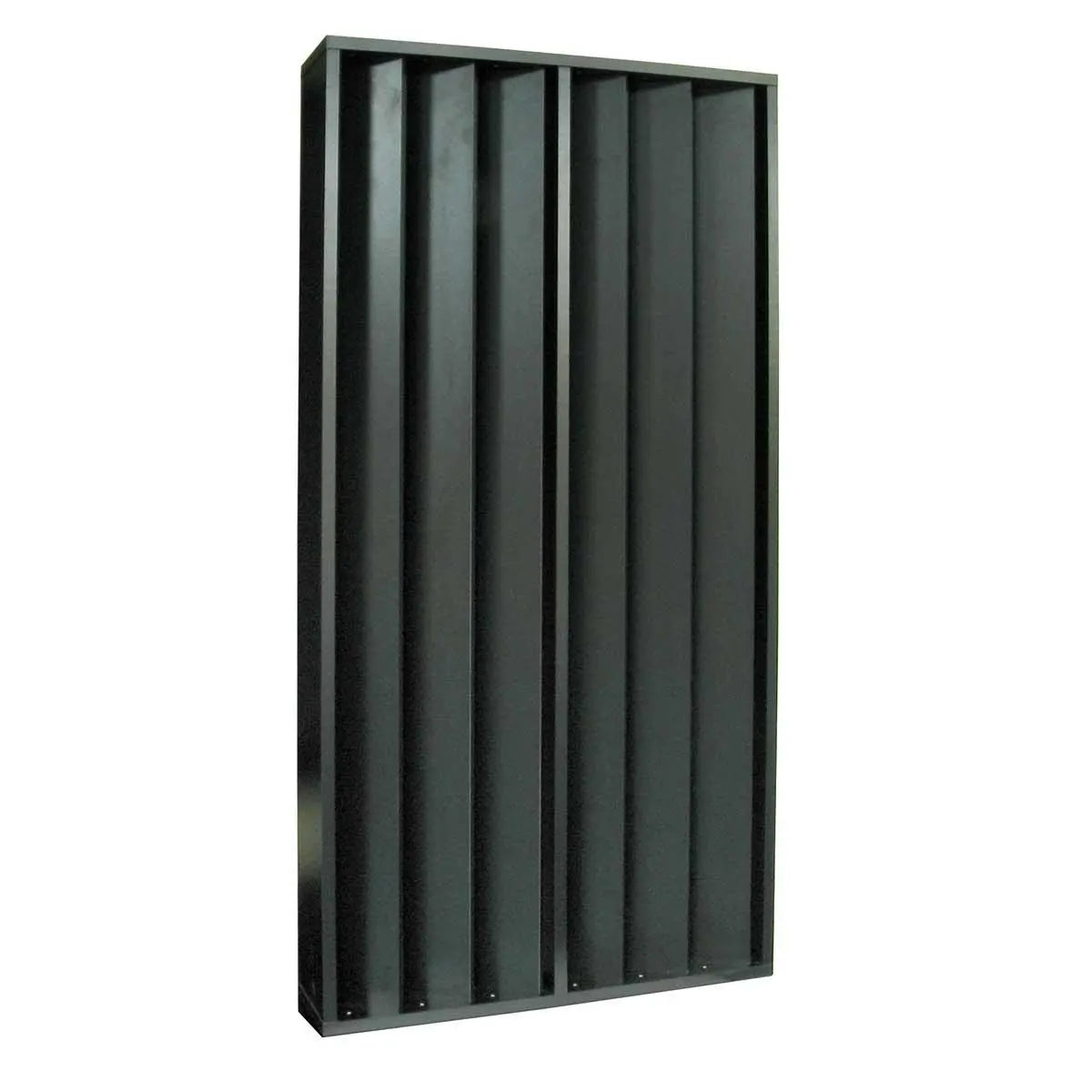
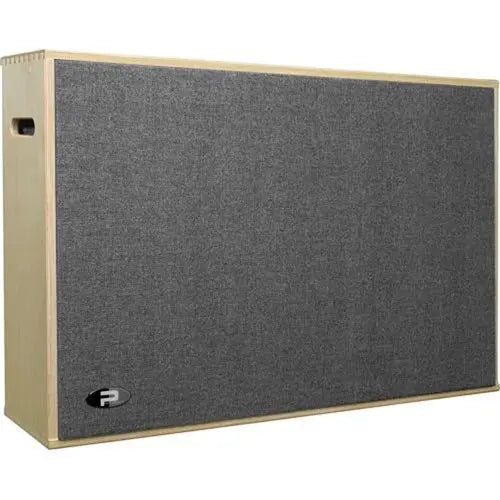
Our baffle range covers both applications. Primacoustic Saturna and Broadway baffles are hanging panels in 305mm × 1219mm and 610mm × 1219mm formats, 38mm deep, available in black, grey and a paintable finish for rooms where the treatment has to match a specification. Primacoustic stackable gobos are 610mm × 914mm × 254mm free-standing units that lock together to build a portable isolation wall to whatever height a session needs. Jocavi Wallblind baffles are mobile, wheeled units for larger commercial installations, available with or without a glazed section where sightlines have to be preserved.
Specifying a large space is not a matter of counting panels. Send us the room dimensions, ceiling height and surface finishes and we will work out the suspended area you need.
A panel mounts flat to a wall, so only its front face absorbs sound. A baffle hangs in open air or stands free on the floor, so both faces work — giving roughly twice the absorption for the same panel size. Panels suit small rooms with available wall space; baffles suit large or high-ceilinged rooms where wall space is scarce.
It depends on room volume, ceiling height and surface finishes rather than floor area alone. As a rough starting point for a hard-surfaced hall or warehouse, suspended baffle area equal to 15–20% of the ceiling area will produce a clearly audible reduction in reverberation. For anything being specified to a target reverberation time, send us the dimensions and we will calculate it.
No. Baffles are absorbers, and absorbers only affect sound within the space they are installed in. Stopping noise passing through a wall, floor or ceiling requires mass, decoupling and airtight sealing — a construction solution, not a treatment product.
Hanging baffles are suspended from ceiling structure, purlins or an existing grid using eyelets and wire or chain, typically at a spacing roughly equal to the baffle depth. Free-standing gobos need no fixing at all — they sit on feet or castors and are moved as the session requires.
Paintable baffles are made for exactly this, using a fabric that accepts water-based paint without closing the pores and destroying the absorption. Standard fabric-wrapped baffles should not be painted — sealing the surface stops them working.
Usually not as the first purchase. In a typical bedroom or garage studio, corner bass trapping and wall panels at the first reflection points will give you more improvement for the money. Free-standing gobos become genuinely useful once you are tracking more than one person at a time, or need to dry up a corner for vocals without permanently treating it.