



















You know the drill. A new orchestral cue lands in your lap, you open the template, and your SSD groans. Modern sample libraries are extraordinary, but they are also enormous, and the price of that realism is a project folder measured in terabytes, a keyswitch map you need a cheat sheet for, and a legato patch that still doesn't quite move the way a real player would.
Dreamtonics reckons there's another way. The company behind Synthesizer V has just released Instrument X, a Neural Acoustics Modeling platform that models orchestral instruments rather than playing back recordings of them — and it runs entirely on your own machine, with no cloud processing involved.
Let's dive into what makes this a game-changer.
Modelling, Not Streaming
The core idea is straightforward even if the maths behind it isn't. Instead of capturing thousands of individual notes at every dynamic and articulation and stitching them together at playback, Instrument X uses neural networks to model how the instrument actually behaves. That means bowing pressure, breath, and register transitions are continuous parameters rather than crossfades between fixed recordings.
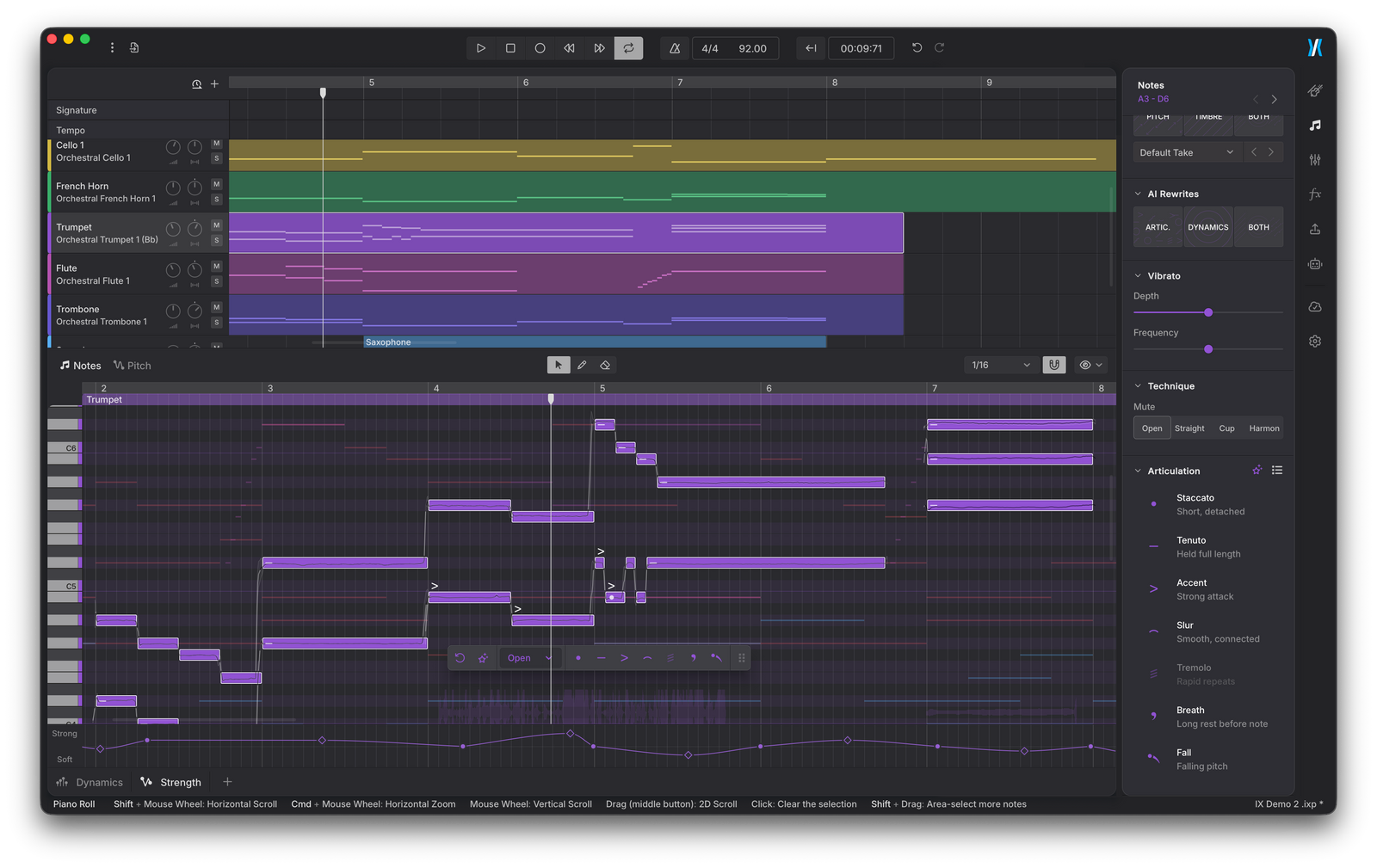
Practically, that changes how a line breathes. Dynamics in Instrument X aren't a volume curve sitting on top of a sample — pushing the Dynamics Lane morphs the underlying timbre, harmonic saturation and kinetic response the way a real player leaning into a phrase would. It's the difference between a crescendo getting louder and a crescendo getting more intense.
Articulations You Play, Not Program
If you've ever lost an afternoon to keyswitch housekeeping, this is the headline feature. Instrument X switches technique based on note pitch and length, so you can simply play the part in and let the engine work out that the short repeated notes want staccato and the long line wants legato. Manual per-note control is still there when you need it — this is an assist, not a hijack.
The Unified Articulation Editor handles both approaches in one place, covering standard symphonic expressions alongside instrument-specific techniques such as string col legno or brass mute configurations. You can also stack and combine articulations on a single note, which opens up hybrid textures that a sample library physically can't produce because nobody recorded that exact combination.
A Scoring Stage You Can Actually Balance
Sounding like an instrument is one thing; sounding like an instrument in a room is the harder problem. Dreamtonics captured the response of real spaces using a custom-built dodecahedral speaker array, and the networks use that data to place each instrument accurately within a virtual scoring stage.
The mixer panel gives you the mic positions you'd expect from a proper orchestral session — close spot mics, Decca tree arrays and wide spaced stereo pairs — so you can dial in intimacy or air without reaching for a reverb plug-in first. If you've been faking a scoring stage with convolution and hope, this is a much more direct route.
Fifteen Instruments, Three Collections
Instrument X launches with 15 instrument expansions grouped into three collections:
- Orchestral Strings Collection — Violin 1, Viola 1, Violoncello 1 and Contrabass 1, built for fluid legato and continuous micro-pitch bowing adjustment. Includes trills, tremolos, falls, portamentos and harmonics, plus dedicated pizzicato, col legno, sul ponticello and sul tasto techniques, and fully modelled con sordino muting.
- Orchestral Woodwinds Collection — Flute 1, Piccolo 1, Oboe 1, Clarinet in A1 and Bassoon 1, with organic breath dynamics and true register transitions. Inhalation breath triggers, major/minor interval trills, expressive falls on clarinet and bassoon, and native harmonics on flute.
- Orchestral Brass Collection — Trumpet 1, Trombone 1, Horn 1 and Tuba 1, with breath tracking across all sections, trumpet trills and tremolos, trombone portamento glides and horn stopped notes. Trumpet and trombone include full modelling for straight, cup and harmon mutes.
The Specs That Matter
- AI Performance Retakes — generate alternative organic takes for a phrase, either re-rolling a whole section or targeting timbre, micro-pitch curves or kinetic intensity separately. Useful when a line is technically right but emotionally flat.
- Advanced polyphony — overlapping notes render as genuinely separate voices instead of cutting each other off mid-bar, so divisi writing and contrapuntal lines stay intact on a single track.
- Runs locally — all processing happens on your computer. No cloud dependency, no internet requirement mid-session.
- System requirements — Windows 11, or macOS 11 and above.
- Pricing — Dreamtonics quotes individual instruments from US$99, with curated bundles and mix-and-match offers starting at US$158. A free 14-day trial is available. Australian pricing hasn't been confirmed at the time of writing, so check with us at Koala Audio for AUD.
Should You Care?
If you write orchestral music and your workflow is bottlenecked by loading times, drive space and keyswitch admin, Instrument X is worth a serious look — and the free trial means you can test it against your own writing rather than a demo reel. If you're deep into a sample library ecosystem you love, this is more likely a complement than a replacement, particularly for sketching and for solo lines that need real expressive shaping.
Either way, it's a genuinely different technical approach to a problem the industry has been throwing storage at for twenty years.
You can shop Dreamtonics at Koala Audio, and browse our full software instruments range