


















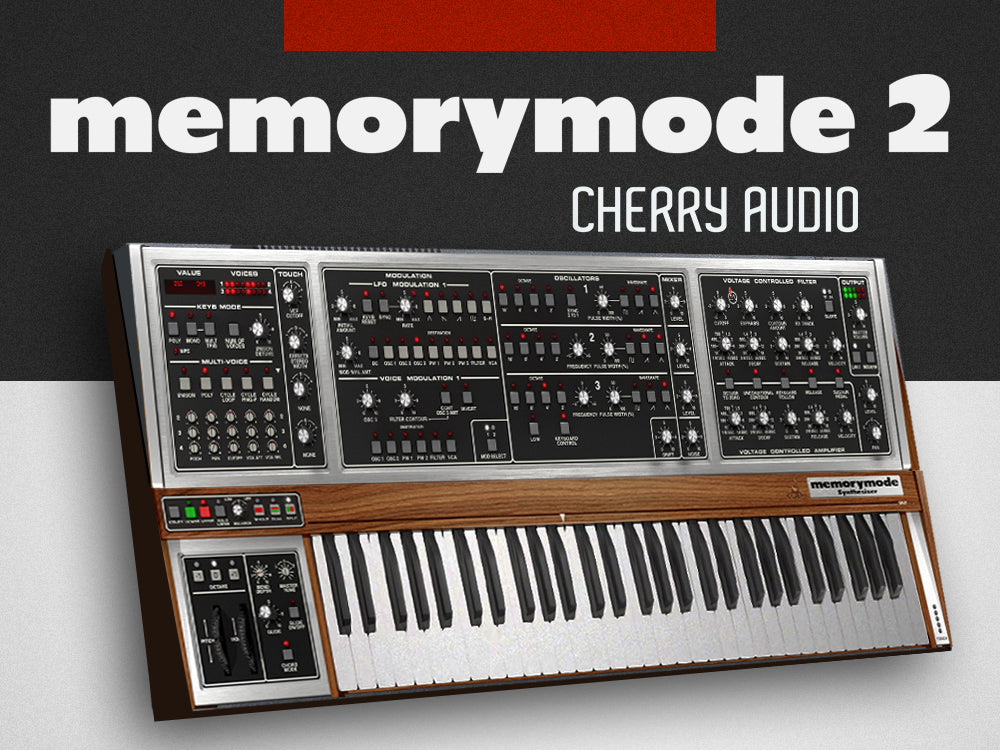

The Moog Memorymoog was described at the time as "six Minimoogs in one" — six voices, three oscillators each, that 24 dB/octave ladder filter, and a sound so big it barely needed a mix. It was also famously temperamental, prone to drifting out of tune mid-session, and today a working one costs more than most home studios.
Memorymode 2 is Cherry Audio's answer to all three problems at once. The original Memorymode landed in 2021 and earned a lot of goodwill for nailing the hardware's tone without any of its reliability headaches. Five years on, this is a full rebuild rather than a maintenance update — redesigned using newer analysis and modelling techniques, and pitched as the definitive successor to both the original hardware and the previous plug-in.
Let's dive into what makes this a game-changer.
Two Synths in One Preset
The biggest structural change is a CPU-optimised dual-layer architecture. Every preset holds two complete 16-voice polyphonic synthesizer layers, which you can stack or split across the keyboard — and each layer can push to 48 voices with unison stacking.
If you've spent time trying to build genuinely huge pads on the original, you'll immediately see what that unlocks. A wide, detuned layer underneath a tight, filtered top layer is now a single patch rather than two instances and a bus. Splits mean bass and lead live in the same preset, which matters if you're playing this live rather than just programming it.
A Better Ladder Filter — And a Modern One
The analogue modelling has been improved across oscillators, filters and envelopes, but the filter is where you'll hear it first. The ladder filter now offers both the classic 24 dB/octave slope and a new 12 dB/octave option for gentler, more open sweeps.
There's also a "modern" setting that pushes beefier lows and more crystalline highs — useful when the vintage voicing sits too politely in a contemporary mix — plus emphasis compensation, which keeps your level and low-end weight intact as you crank resonance. Anyone who has ever lost all the bass out of a patch while dialling in a resonant sweep will appreciate that last one.
Analog drift control is on board too, so you can add back exactly as much instability as you want. Which is a rather nicer arrangement than the hardware, where the instability decided for you.
Expression, Modulation and Movement
Memorymode 2 goes well past what the original hardware could do in performance terms. There's velocity sensitivity, polyphonic aftertouch and full MPE support, so if you're playing a Roli, an Osmose or an MPE-capable controller, the per-note expression actually lands.
Modulation runs to four lanes of touch-oriented routing with 52 destinations, and each layer gets its own 16 x 4 programmable polyphonic step sequencer and arpeggiator. The Touch Animator adds performance-based automation on top — essentially a way to record and replay gestural movement rather than drawing it in your DAW.
Rounding it out are three independent effect chains carrying 22 studio-quality effects, including a new Wide Phaser and Rotary Speaker.
The Spec Sheet
- Dual-layer architecture: two complete 16-voice layers per preset, stackable or splittable, up to 48 voices per layer with unison.
- Refined ladder filter: 24 dB and 12 dB per octave slopes, a "modern" voicing option, and emphasis compensation to hold level and low-end under resonance.
- Analog drift control: dial in as much vintage instability as the part needs — or none.
- Full expression support: velocity, polyphonic aftertouch and MPE, plus a new multi-voice mode and single-key chord mode.
- Deep modulation: four lanes of touch-oriented modulation with 52 routing destinations.
- Per-layer sequencing: 16 x 4 programmable polyphonic step sequencers and arpeggiators on each layer, plus the Touch Animator for gestural automation.
- Three effect chains: 22 effects including the new Wide Phaser and Rotary Speaker.
You can shop Cherry Audio at Koala Audio for the full range of Cherry Audio instruments.