



















You know the moment. You've outgrown the two-in, two-out box that got you started. You want to track a vocal and a guitar at once, run a headphone mix for someone else in the room, patch in that 500 Series compressor you've been hoarding, and still have somewhere to plug the drum machine. Suddenly your entry-level interface is the bottleneck in an otherwise capable studio.
The Flex-10 is Harrison's answer to exactly that squeeze — a 10-in/12-out USB-C and ADAT desktop interface announced on 18 August 2026, and the first audio interface to carry the Harrison name in its own right. It takes the analogue character that made Harrison consoles the centrepiece of studios behind records by Led Zeppelin, Nirvana, Michael Jackson and The Rolling Stones, and drops it onto your desk in a box you can actually reach.
Let's dive into what makes this a game-changer.
H-DRIVE: Saturation Where It Actually Counts
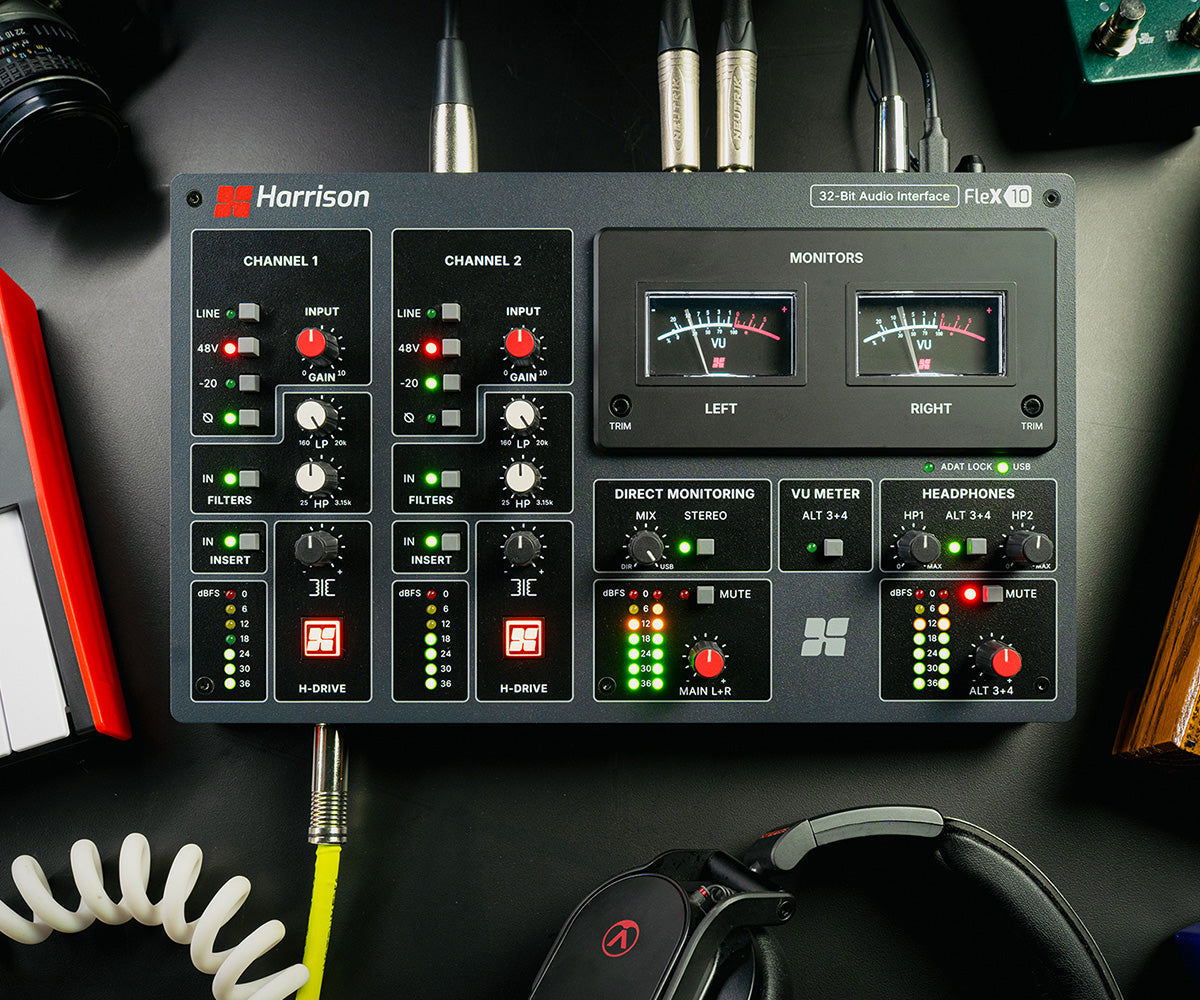
The two mic preamps are the headline act, and each one carries H-DRIVE — real transformer saturation, controlled from the front panel. This is not a plug-in emulation sitting after the fact; it's an analogue circuit shaping the signal on the way in. Push it and you get the thickening and gentle harmonic grit that a '70s console does to a source before you've touched a single fader.
Alongside it sit classic Harrison high-pass and low-pass filters on both channels, derived from the filters in the 32 Series consoles. Being able to roll off rumble or tame harsh top end at the input stage means you commit to a better-sounding take rather than fixing it in the mix three weeks later. Each channel also gets line-level switching, 48V phantom power, a -20 dB pad and phase inversion — the practical stuff you reach for constantly.
Ten In, Twelve Out: Room to Actually Grow
Where the Flex-10 earns its name is connectivity. Eight channels of ADAT I/O mean your two-preamp desktop unit can expand into a proper tracking rig when the session demands it. Harrison specifically point to pairing it with their D510r 500 Series rack and D510ua ADAT interface for a hybrid setup, but any ADAT-equipped preamp bank will do the job.
Two Hi-Z instrument inputs sit on the front panel — a small detail that matters enormously when you're plugging a bass in for the fourth time that evening rather than reaching around the back. There are also balanced insert points on both channels, so your outboard compressor or that boutique pedal can live permanently in the signal path instead of being a patching chore.
A Monitoring Section That Respects Your Workflow
Two independent monitor outputs, each with its own level control, let you A/B between your mains and a second reference pair without a separate controller. Two high-end headphone outputs mean you and a vocalist can both be properly looked after. And there are VU meters — genuinely useful for reading level at a glance, and, let's be honest, very good to look at.
MIDI I/O arrives over 3.5 mm TRS connectors, keeping synths, drum machines and controllers in the loop without a separate box.
The Software Bundle Isn't an Afterthought
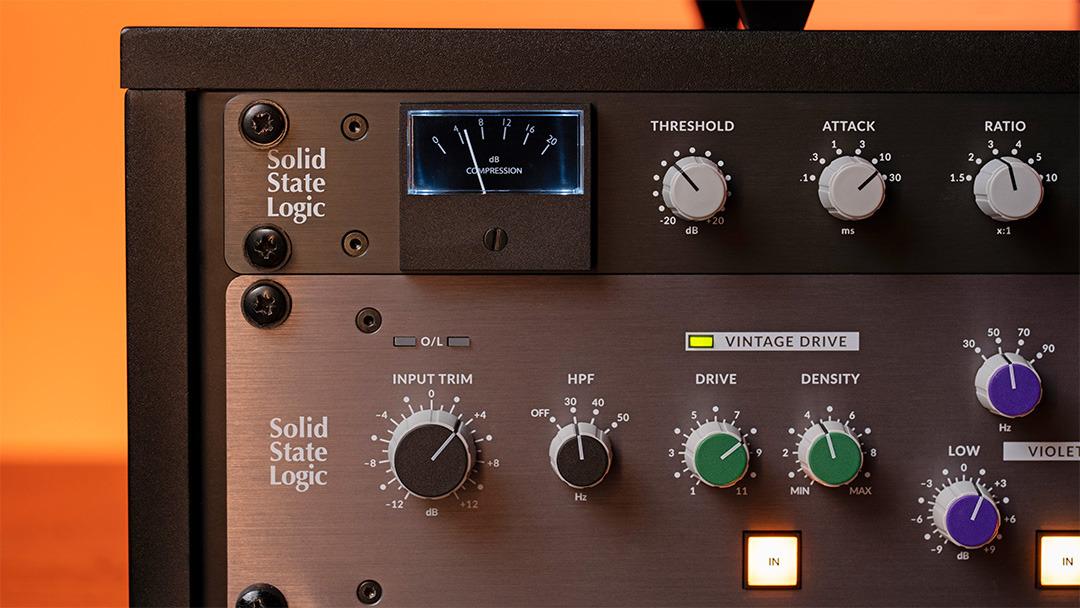
Flex-10 ships with a full licence for Harrison Mixbus 12, the analogue-console-inspired DAW with Harrison's signature console EQ on every channel. It also includes the Harrison Creator Pack — virtual instruments, plug-ins, loops and samples contributed by partners including Solid State Logic, Slate Digital, Sonible, AAS, Native Instruments and IK Multimedia. That's a genuine head start if you're building a room from scratch.
The Specs That Matter
- I/O: 10 inputs, 12 outputs over USB-C — two mic preamps, two Hi-Z instrument inputs, two line inputs, plus eight channels of ADAT.
- Conversion: 32-bit/192 kHz converters, so you're not compromising resolution for character.
- Analogue front end: two H-DRIVE transformer saturation circuits, classic Harrison high-pass and low-pass filters, -20 dB pad, phase invert and 48V phantom per channel.
- Outboard integration: balanced insert point on each channel for compressors, 500 Series modules or pedals.
- Monitoring: two independent stereo monitor outputs with individual level control, two headphone outputs, VU metering.
- MIDI: MIDI in and out over 3.5 mm TRS.
- Compatibility: class-compliant on macOS; ASIO driver supplied for Windows.
- Bundled software: Harrison Mixbus 12 DAW and the Harrison Creator Pack.
- Pricing: $1099
Who Is This For?
If you're recording one source at a time into a two-channel box and never running out of room, the Flex-10 is more interface than you need. But if you're tracking a couple of sources together, want outboard in the chain, need a second headphone feed, or you can see an ADAT preamp bank in your future, this sits in a genuinely useful spot — more capable than an entry-level unit, without the price or footprint of a rack-mounted system.
What tips it over the line for a lot of people will be the front end. Plenty of interfaces in this bracket are deliberately clean and neutral. The Flex-10 gives you the option to be clean when the source calls for it, and to lean into transformer saturation and console filters when it doesn't. That's a creative decision you get to make at the input stage, which is where it counts most.
Ready to add some Harrison heritage to your setup? Shop Harrison at Koala Audio.