















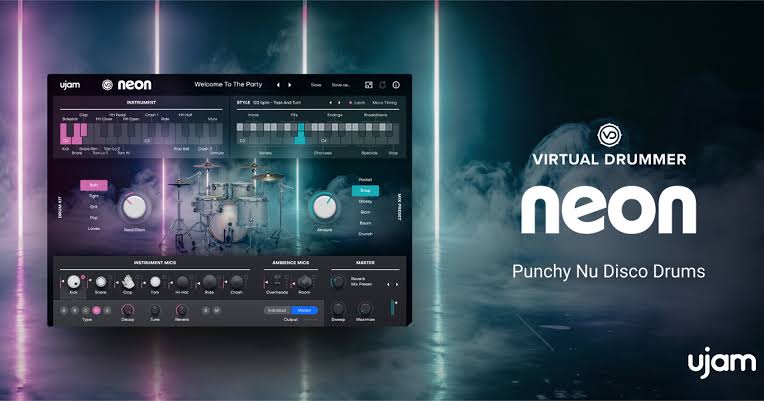

You know the sound the moment it starts. That tight, snappy, sitting-right-on-top-of-the-mix disco backbeat that gets a track moving before the vocal has even landed. Trouble is, chasing it inside a conventional acoustic drum library usually means an afternoon of velocity layering, ghost-note programming and mix fiddling — and what comes out the other end still tends to sound like a grid rather than a groove.
UJAM Virtual Drummer NEON is built to let you skip that detour entirely. It is a nu disco and dance-pop drummer plug-in that hits with the punch of a drum machine but phrases like an actual human behind a kit, and it arrives already mixed rather than raw. Point it at your track, pick an energy level, and you have a rhythm bed in minutes.
Let's dive into what makes this a game-changer.
Vintage Kits, Modern Muscle
NEON's five kits were not assembled from whatever was lying around. UJAM built them from 1970s Rogers and Gretsch kicks and toms, 1980s Sonor Phonic toms and a DW kick, with snares drawn from a Ludwig Supraphonic, a Ludwig Acrolite, a Rogers Dynasonic, a Tama Mastercraft and a PDP. Cymbals come from Paiste, Zildjian and Sabian.
The tracking is where the character really comes from. Producer and engineer Bernhard "Böni" Hahn — 35 years deep, with credits including Kim Wilde, Nena and Tarja Turunen — close-miked every drum and added overhead and room pairs, running everything through a vintage Studer 962 console, Neve 1073 and 1081 preamps, a Universal Audio 4-710 and a Summit Audio EQP 200 EQ. Microphones spanned Shure, Sennheiser, AKG, Beyerdynamic, Coles and Horch models.
The kits were deliberately tuned and recorded to be dry, tight and punchy rather than big and roomy, then handed to a mixing console built into the plug-in itself. That combination of period-correct capture and modern processing is what gives NEON its signature snap — and it's why the drums drop into a busy synth-pop arrangement without needing a stack of corrective EQ first.
A Session Player That Takes Direction
Where NEON separates itself from a sample library is in how you drive it. Rather than programming hits, you choose one of 30 styles to match your genre and energy, then pick and combine drum phrases for intros, verses, choruses and fills. There are 23 phrases per style — 690 grooves in total — all built from human performances rather than quantised patterns.
You can stay entirely in the zone and trigger those grooves from single MIDI keys, locked to your DAW's tempo, or drag any phrase into your session as a MIDI clip and edit it like you would any other part. That second option matters more than it sounds: it means NEON works as a fast sketching tool early on and a genuine starting point for a bespoke part later, instead of forcing you to commit to a canned loop.
A hundred presets are on hand if you'd rather start from a finished sound and tweak from there. The grooves themselves carry the endorsement of musical director Nate Williams, formerly of Jamiroquai and Steve Winwood's band, who notes that NEON's sounds push comfortably beyond disco into rock and hip-hop territory.
The Real/Glam Slider: Raw to Radio in One Move
The control you'll reach for most is the Real/Glam slider. Wind it toward Real and the kit stays natural and acoustic; wind it toward Glam and the drums grow bigger, slappier and closer to electronic. It's a single macro that would otherwise be a parallel compression chain, a transient shaper and a bit of saturation, and it makes matching the drums to a track's production style almost trivially quick.
Six mix presets sit alongside it, taking you from snappy and dry through to crunchy and slammed. There are proper claps too — recorded live by a trio, combining a direct mono signal with stereo room and overhead mics for a wide image designed to sit with the snare rather than fight it. And when you want full control, separate outputs for each drum sound let you mix the kit your own way.
The Specs You Need to Know
- Five acoustic drum kits — each with seven individual instruments (kicks, snares, hats, toms, cymbals) plus overhead and room mics, and kits can be mixed and matched.
- 690 drum grooves across 30 styles — 23 phrases per style, covering nu disco, dance-pop, house, disco house, synthwave and 80s-leaning chart pop.
- Real/Glam slider and six mix presets — instant control over how acoustic or processed the kit sounds, plus 100 factory presets.
- Separate outputs and MIDI drag-and-drop — send individual drums to their own channels, or pull any phrase into your DAW as editable MIDI.
- Formats — VST2, VST3, AU2 and AAX, 64-bit only, on Windows 10 and 11 and macOS Big Sur (11) through Tahoe (26). Runs natively on Apple silicon as well as Intel Macs.
- System requirements — 8GB RAM, 1.4GB free disk space, a 1280x768 display and an internet connection for authorisation.
Is It Worth Your Attention?
If your productions live around synths and a danceable backbeat, NEON is aimed squarely at you. It isn't trying to be a general-purpose acoustic drum production tool — UJAM has been quite upfront about that — and the trade-off is a plug-in that gets you to a convincing, mix-ready nu disco groove far faster than a raw multi-mic library ever will. The seven-day trial makes it an easy one to audition against your own track.
You can shop UJAM at Koala Audio for the full range of Virtual Drummer, Virtual Bassist, Virtual Guitarist and Usynth titles.