


















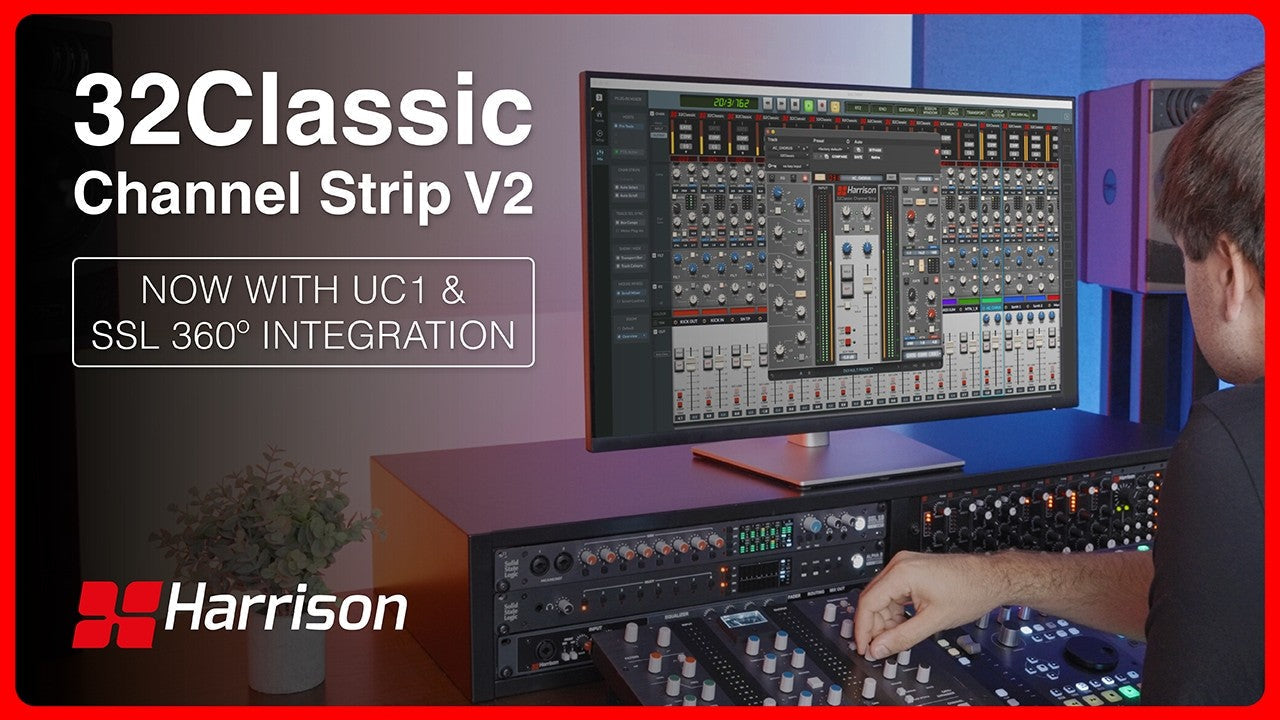

Most channel strip plug-ins ask you to build a sound. A console strip does something different — it gives you a starting point that already has an opinion, and you spend your time steering rather than searching. That's the appeal of the Harrison 32Classic: it's modelled on a desk that quietly sat under a lot of records you know.
32Classic Channel Strip V2 is Harrison Audio's major update to that plug-in — and the most interesting change isn't a new band of EQ. It's that the strip now behaves like it belongs on your control surface.
Let's dive into what makes this a game-changer.
Hands On the Strip, Not on the Mouse
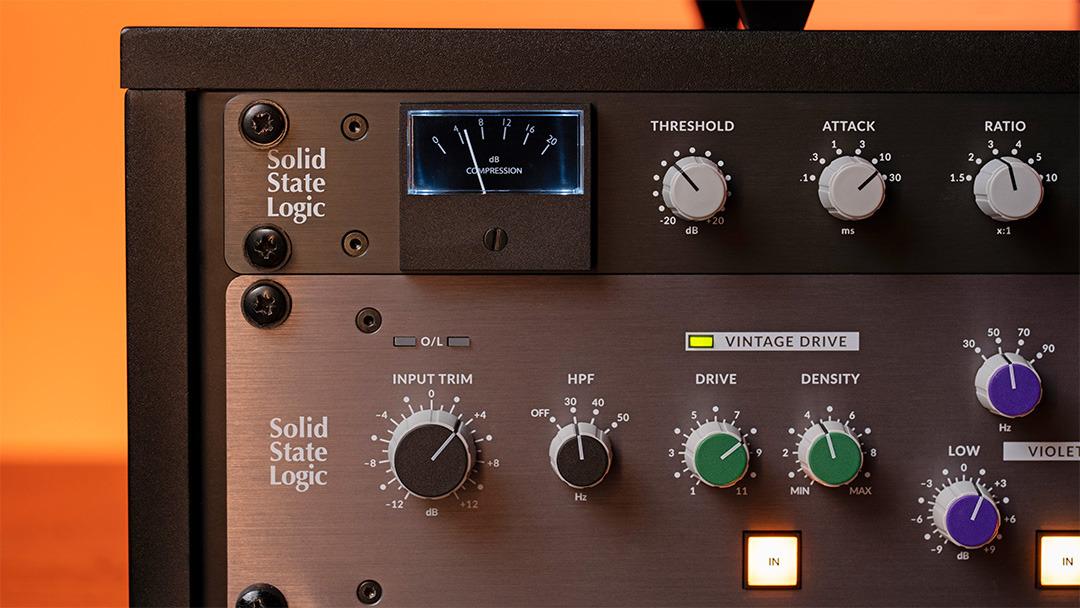
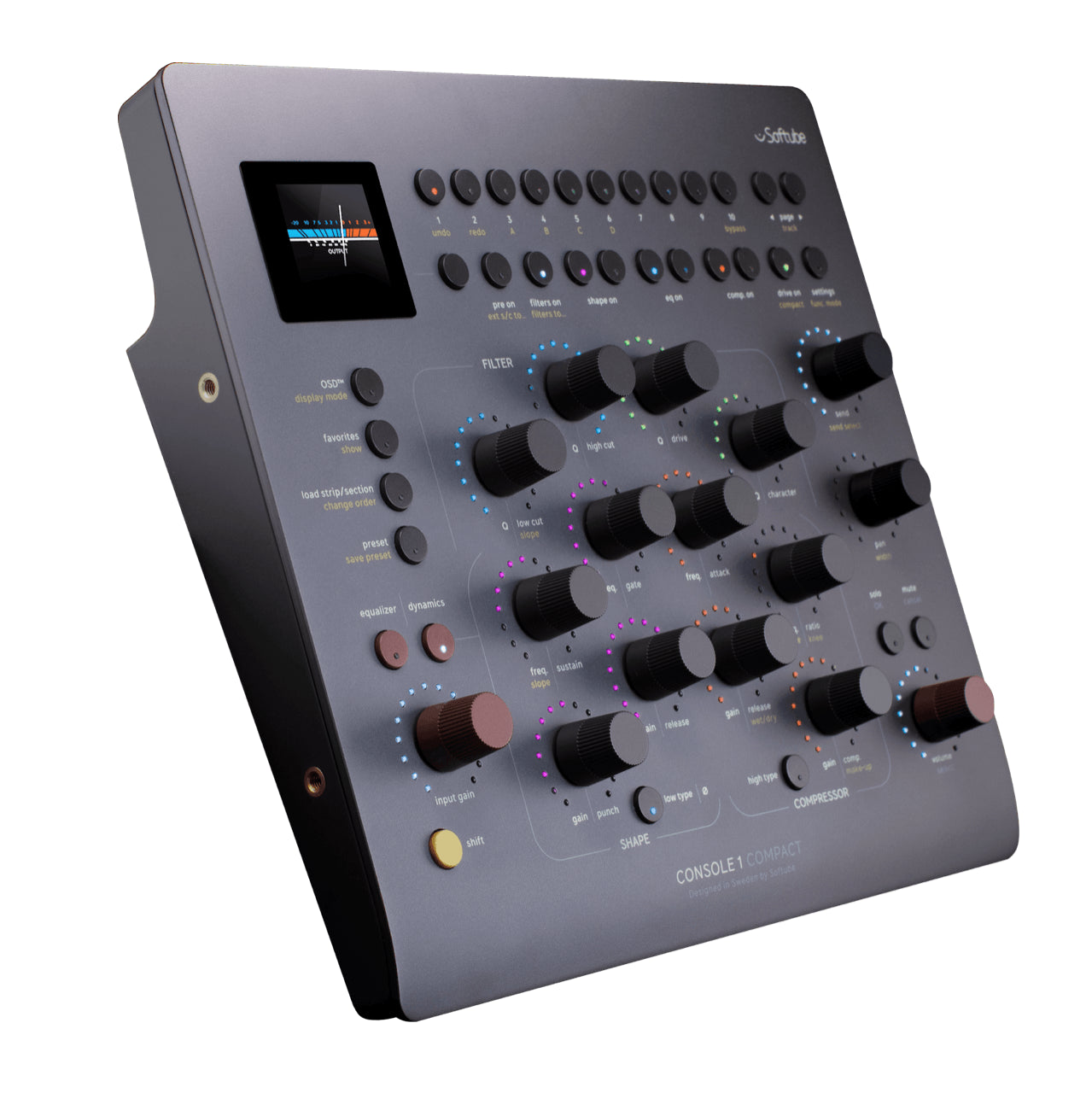
The standout addition in V2 is native SSL 360° and UC1 integration. Previously, getting hardware control over the 32Classic meant going through SSL 360° Link. Now you can insert the updated plug-in directly into a DAW session and control it from the UC1 without that intermediate step, and it appears natively in the SSL 360° Plug-in Mixer alongside SSL's own channel strip plug-ins.
If you run a UC1 and you've been switching between the SSL strip and the Harrison strip depending on the source, that's a real workflow change. Both now live in the same layer, controlled the same way, with the same muscle memory.
The Sound of a Working Console
The 32Classic itself emulates the Harrison 32Classic analogue mixing console — a desk with a long track record in music and post. The plug-in is a fully featured strip rather than a stripped-back tone box: four-band parametric EQ, high-pass and low-pass filters, transformer saturation with a Drive control, a compressor and a gate/expander, all in one window.
The transformer saturation is the part worth spending time on. Push the Drive and you get the thickening and gentle top-end restraint that makes a dry DI or a clinical digital capture sit more comfortably in a mix. Used across a group bus it does the "glue" job without you reaching for a separate saturator.
Where It Fits in Your Session
Because it's a whole strip in one instance, the 32Classic works best as a default insert rather than a specialist tool — the thing you drop on every channel first and then decide what to engage. Filters to clear the low end, EQ to shape, compressor to hold it steady, saturation to give it weight. On a busy session that's fewer plug-in windows and less CPU housekeeping than chaining four separate processors per track.
The Specs That Matter
- Four-band parametric EQ: Broad, musical shaping across the full range — the console-style curves rather than surgical notches.
- High-pass and low-pass filters: Clear rumble and tame fizz before the EQ has to do the work.
- Transformer saturation with Drive: Analogue-style harmonic thickening, dialled in by ear with a single control.
- Compressor: Onboard dynamics so a single instance handles level control as well as tone.
- Gate/expander: Useful on drums, noisy amps and dialogue where you want the gaps to stay quiet.
- SSL 360° and UC1 integration: Native control from the UC1 with no SSL 360° Link required, and native appearance in the SSL 360° Plug-in Mixer.
- Pricing: SSL list the 32Classic Channel Strip at USD $149. SSL hardware owners are listed at USD $74.50 for V2, with an SSL Family offer for UC1, UF8 and UF1 owners reported at USD $19.99 for the first 30 days after launch. These are overseas figures — check with Koala Audio for AUD pricing and current eligibility rather than converting them yourself.
Worth the Upgrade?
If you already own a UC1, UF8 or UF1, the answer is close to obvious — V2 turns a plug-in you were driving with a mouse into one you can drive with your hands, and the launch-window pricing for SSL controller owners is aggressive. If you're coming to it fresh, the 32Classic remains one of the more characterful console strips going, and V2 is the version to start on.
Want to know how it sits next to the SSL Channel Strip 2 in a real session? Shop Harrison at Koala Audio and we'll talk you through it.
What do you think? Let us know in the comments below!