




















Every producer has a delay plug-in they reach for and a delay plug-in they actually want. The first one is clean, precise and does exactly what the manual promises. The second one — the one you keep hunting for — darkens every repeat, smears the tail slightly, and drifts just enough that a static loop starts to feel like it is breathing.
That second thing is what bucket-brigade device (BBD) hardware did more or less by accident, and it is exactly what PSPaudioware has gone after with PSP BBDelay.
Let's dive into what makes this a game-changer.
Dynacord Heritage, Imperfections Included
The reference point here is the Dynacord VRS 23, a unit with a reputation for repeats that feel alive rather than photocopied. PSP have modelled the BBD chips themselves, the compander behaviour that sat around them, and the analogue circuit imperfections that came along for the ride.
That last part matters more than it sounds. In a real bucket-brigade circuit, the signal is handed from capacitor to capacitor thousands of times per second, losing a little high end and picking up a little noise on every pass. Companding was used to keep the noise floor manageable, and it left its own fingerprint on the dynamics of each echo. Model the chips without modelling the compander and you get a dark delay; model both and you get the pumping, breathing quality that makes BBD echoes sit behind a vocal without ever competing with it.
PSP have also included a BBD chip variation control, so repeats do not stack up identically the way a purely digital delay line would. If you have ever wondered why a hardware echo on a snare sounds different on bar four than it did on bar one, this is the parameter that reproduces it.
Everything the Original Units Could Not Do
PSP were clearly not interested in building a museum piece. Extended parameter ranges take BBDelay well past what the source hardware managed, which means the same plug-in covers tight slapback on a rockabilly guitar, rhythmic dub-style throws, and long ambient washes that blur into pad territory.
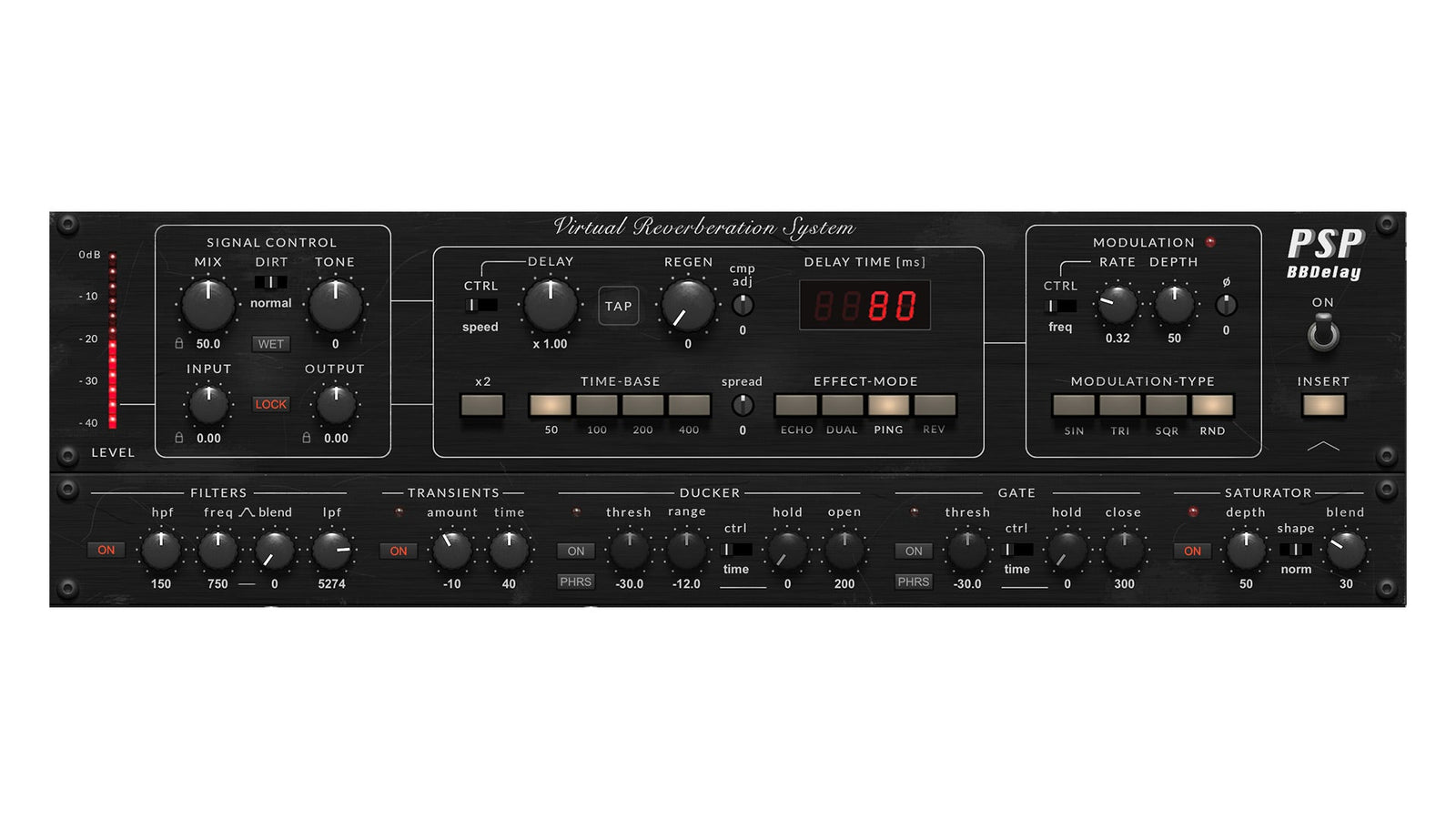
On top of that sits a set of tools that no 1970s echo unit had: built-in transient shaping, ducking and gating. Ducking is the one that will earn its keep fastest in a busy mix — set it up on a lead vocal and the repeats politely step out of the way while the singer is working, then bloom in the gaps. Gating gives you the stuttered, chopped echo effect without automating a separate plug-in, and transient shaping lets you decide whether each repeat arrives with a snap or a swell.
Tone Shaping That Stays Out of Your Way
Filtering, analogue-style saturation, modulation, adjustable tone shaping and stereo spread round out the feature set. In practice that means you can dial a delay from clean-ish and wide down to narrow, filthy and mono without leaving the plug-in or stacking three utilities behind it.
The stereo spread control is worth flagging for anyone mixing in a small room. Wide delays are a cheap way to create space, but they can also hollow out the centre of a mix if you push them too far. Having spread on the same panel as saturation and filtering makes it much easier to hear the trade-off as you make it.
Specs, Formats and Pricing
- Modelling: BBD chips, compander behaviour and analogue circuit imperfections, inspired by the Dynacord VRS 23.
- Creative processing: transient shaping, ducking and gating built in, so the delay reacts to your source rather than sitting on top of it.
- Tone and movement: analogue-style saturation and modulation, adjustable tone shaping, stereo spread, plus BBD chip variation for repeats that evolve.
- Range: extended parameters covering classic slapback, rhythmic effects, lush ambience and outright sound design.
- Formats: VST3, AU and AAX — so it drops straight into Pro Tools, Logic, Cubase, Studio One, Live and the rest.
- System requirements: Windows 7 or later, macOS 10.15 or later.
- Authorisation: PACE iLok, with no USB dongle required.
Who Is It For?
If your delay folder is already deep in tape emulations and pristine digital lines, BBD is the third flavour you are probably missing. Tape delays wobble and compress; digital delays repeat faithfully; bucket-brigade sits between the two, dark and slightly unstable but without tape's pitch drift. On guitars, electric pianos, drum machines and vocals it does something neither of the others quite manages.
You can shop PSP Audioware at Koala Audio for the rest of the range.