
















Reverb is the thing that quietly separates a mix that sounds like a record from a mix that sounds like a demo. It's also the thing most of us compromise on. You reach for whatever algorithmic reverb shipped with your DAW, spend twenty minutes fighting the pre-delay, and settle for something that sits behind the vocal rather than lifting it.
The reverbs that actually did the lifting on the records you grew up with have historically been locked away — first behind studio doors, and more recently behind DSP hardware. That's changing. UAD EMT 140 Classic Plate Reverberator and UAD EMT 250 Classic Electronic Reverb, two of Universal Audio's most respected emulations, now run natively on any Windows or macOS machine, no Apollo interface, no UAD Satellite, no DSP budget to manage.
The EMT 140: The Plate Behind Half Your Record Collection
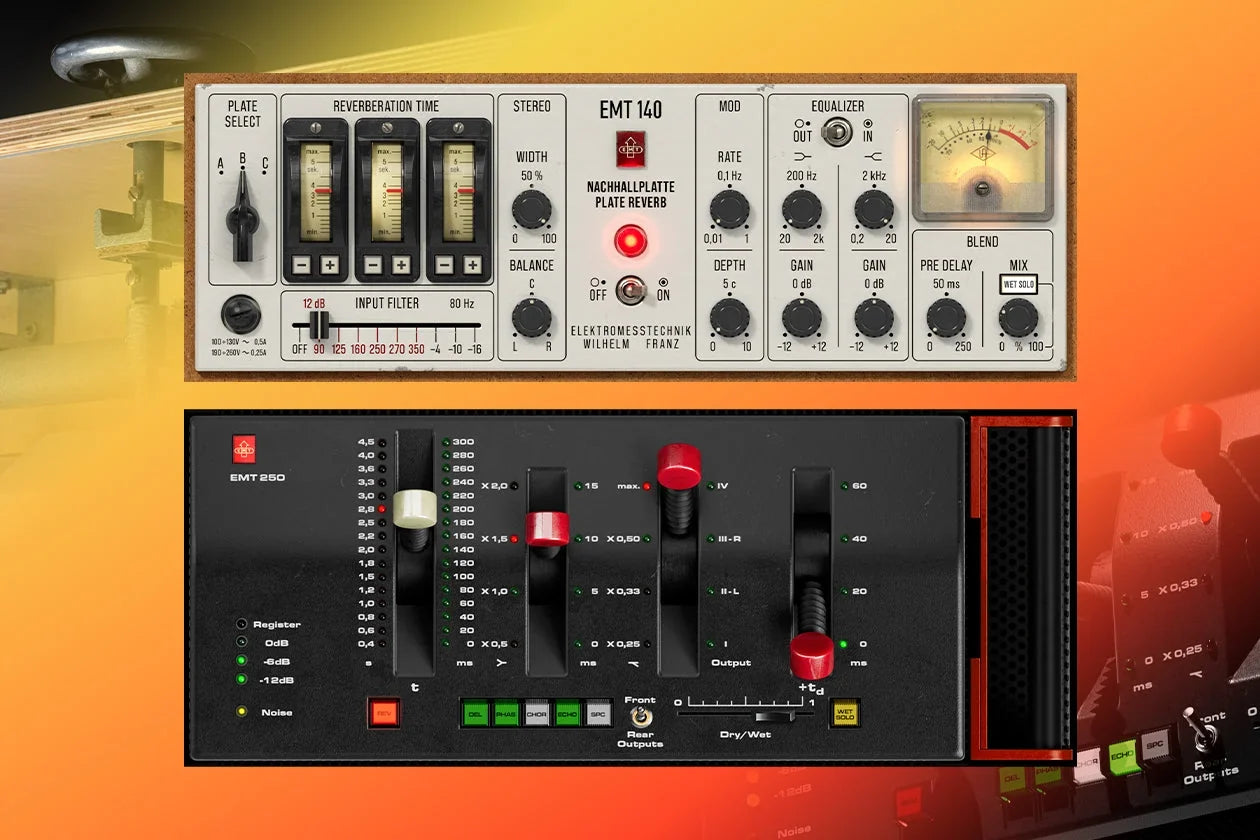
The original EMT 140 was a sheet of steel in a wooden box, roughly the size of a wardrobe, and it defined the sound of studio reverb from the late 1950s onward. If you've heard a Beatles vocal, a Pink Floyd guitar or an Adele chorus, you've heard a 140 doing its work.
Universal Audio modelled three individual EMT units at The Plant Studios in California, and the differences between them matter. Real plates drift, the tension, the damping, the room they sit in all leave fingerprints. Having three to choose from means you can pick the one that suits the track rather than reaching for a single generic setting.
- Three modelled units: Each captured from a physical EMT 140 at The Plant, so you get genuine unit-to-unit variation instead of one preset with a size knob.
- Damping and filter controls: The same tools an engineer would have used on the hardware — shorten the decay, roll off the top, keep the tail out of the way of the vocal.
- Balance, Width and Modulation: Plug-in-only additions that let you widen the stereo image or add subtle movement, things the physical box simply couldn't do.
- Best on lead vocals: This is the classic use case. A 140 sits a vocal in a space without pushing it backwards in the mix.
The EMT 250: Seventies Digital That Still Sounds Expensive
Where the 140 is steel and physics, the EMT 250 is one of the first digital reverbs ever built, a 1976 machine with aircraft-style control arms that plenty of engineers still rate as the best-sounding reverb ever made. Very few exist. Fewer still are in working order.
Universal Audio built this emulation from an algorithm sourced directly from a ‘golden unit’ at Ocean Way Recording, and it's the only EMT 250 emulation fully endorsed by EMT International. That endorsement isn't marketing garnish — it means the reference material came from the source rather than from a competitor's guesswork.
- Sourced from a ‘golden unit’: Modelled from a specific, highly regarded 250 at Ocean Way, not a composite.
- Six modulation effects: Beyond reverb, you get delay, phasing, chorus and echo, the same seventies-flavoured effects the hardware offered.
- Officially endorsed: The only emulation carrying EMT International's approval.
- Heard on the classics: Records by Pink Floyd, Prince and Elvis Costello, among many others.
Native Means No Gatekeeping
This is the part that actually changes your workflow. Until now, running these plug-ins meant owning UAD hardware and rationing DSP across a session. Native versions remove both constraints. You can open twenty instances if your CPU allows, freeze them, bounce them, and open the session on a laptop in a hotel room without dragging an interface along.
It also means the mix you build at home opens correctly on someone else's system, which matters more than it sounds if you collaborate or hand sessions off for mixing.
- Formats: VST3, AU and AAX, so Pro Tools, Logic, Ableton Live, Cubase, Studio One and Reaper are all covered.
- System requirements: Windows 10 or higher; macOS 10.15 or higher.
- No hardware required: Apollo and UAD Satellite owners can keep using them, but they're no longer a prerequisite.
Which One Should You Reach For?
If you mostly track vocals and acoustic instruments and want a reverb that flatters without drawing attention, start with the 140. Its plate character is dense and quick, and it glues a vocal to a track in a way most algorithmic reverbs can't quite manage.
If you're after character : drum rooms with attitude, synth pads that shimmer, or that unmistakable seventies sheen on a snare, the 250 is the more distinctive tool. Plenty of engineers own both and use them for entirely different jobs, which is the honest answer.
Either way, two of the most-used reverbs in recording history no longer require a hardware purchase to get into your sessions. That's a genuinely good day for anyone mixing on a laptop.
Shop Universal Audio at Koala Audio for the full UAD plug-in range, including both EMT reverbs.