
















Some of the best "effects" on classic records were never effects at all, just a second voice sitting a few milliseconds behind the first. That thick, double-tracked sound is easy to hear and surprisingly hard to fake with a modern digital delay, which tends to sound either too clean or too obviously like an echo.
Universal Audio's Cooper Time Cube has been one of the go-to answers for UAD users for years, and now it has gone native. The new UAD Cooper Time Cube runs on your computer's CPU in VST3, AU and AAX formats on macOS and Windows, so you no longer need DSP hardware to get that classic doubling and slapback into your mix.
Let's dive into what makes this one worth a spot in your plug-in folder.
A Garden Hose With a Great Sense of Timing
The original Cooper Time Cube was a 1971 hardware unit designed by Bill Putnam and Duane H. Cooper. Instead of tape or chips, it sent audio through a coiled length of garden hose and picked it up again at the other end. The result was a short, slightly coloured delay that studios used to thicken vocals, guitars and keys without the smeared, washy tail of a reverb.
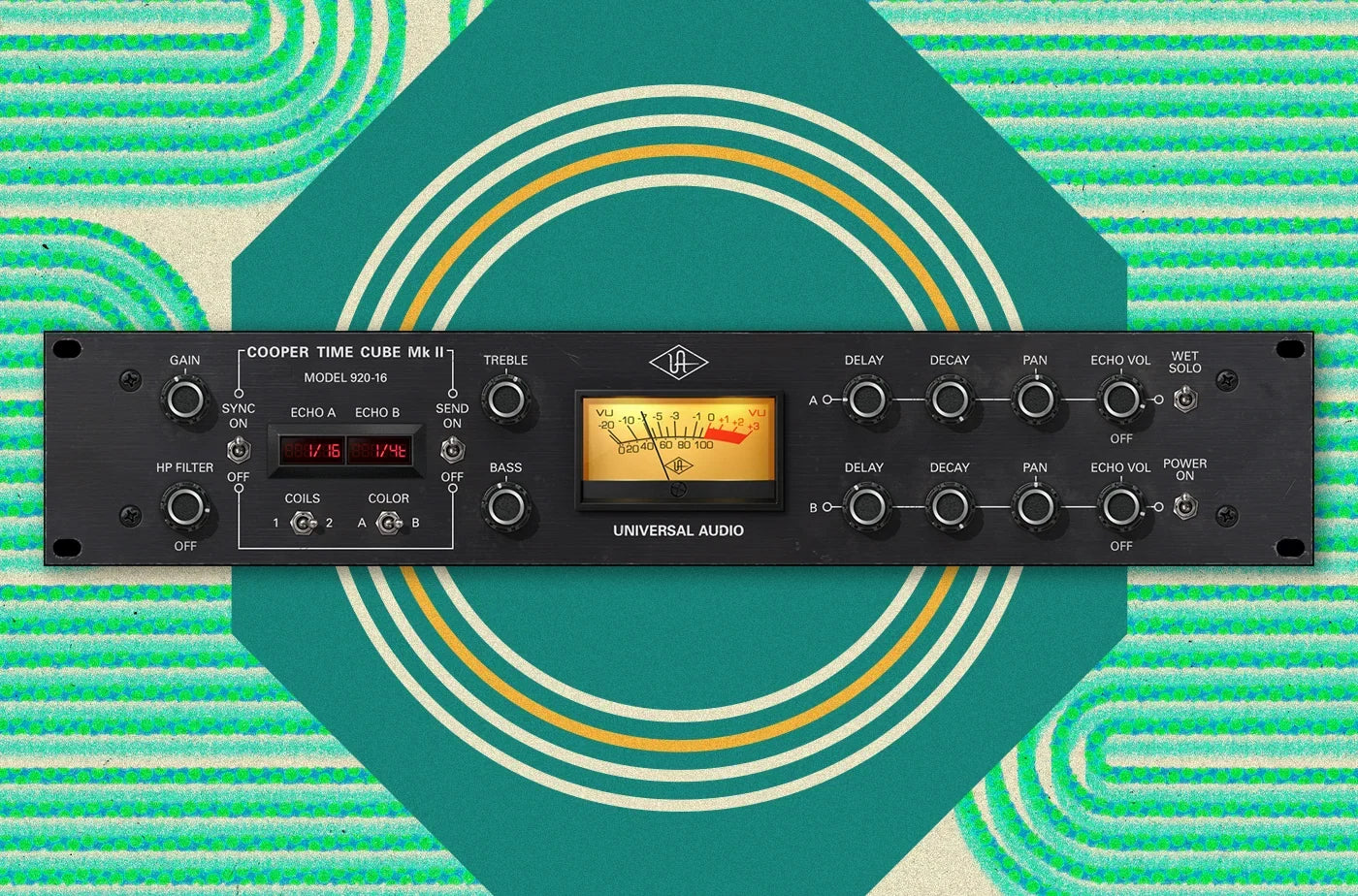
The native plug-in models that behaviour, right down to a switch that lets you pick single or double hose coil operation. Universal Audio pitches the sound as natural doubling, tight slapback and colourful echo, which is exactly the territory where this kind of delay earns its keep.
Dual Delay Lines for Instant Width
Under the hood you get two independent delay lines, each with its own Decay, Pan and Volume controls, and each can be synced to your session tempo. Pan one line left and one right with slightly different times and your mono vocal or guitar suddenly fills the stereo field, while the centre of your mix stays clear for the kick, snare, bass and lead.
Each line covers a range of 5 ms up to 2.5 seconds, so you are not limited to doubling either. Push the times out and you have rhythmic, tempo-locked echoes with the Time Cube's character baked in.
Tone Shaping That Keeps Repeats in Their Lane
Delays often get into trouble when the repeats fight with the dry signal. The Cooper Time Cube gives you Treble, Bass and Color controls plus a High Pass Filter to shape the repeats, so you can roll off low-end mud or darken the echoes until they sit behind the source rather than on top of it. Every knob is automatable, which makes it easy to open the delay up for a chorus and pull it back in the verses.
Key Features and Specs
- Organic doubling: short delays that thicken vocals, guitars and keys without sounding like an obvious effect.
- Dual delay lines: two independent lines with their own Decay, Pan and Volume, each with tempo sync.
- Delay range: 5 ms to 2.5 s per line, from tight doubling to longer rhythmic echoes.
- Tone controls: Treble, Bass, Color and a High Pass Filter to keep repeats out of the way of your dry signal.
- Coil switch: choose single or double hose coil operation for different flavours of the original hardware.
- Full automation: every control can be automated in your DAW.
- Formats: native VST3, AU and AAX, plus LUNA, on macOS (including native Apple Silicon support) and Windows. Universal Audio also lists it as running on Apollo interfaces and UAD Accelerators.
Who Is It For?
If you track vocals, this is the kind of tool you reach for when a single take feels a little thin but a full double-track would be too much. Guitar players will get a lot out of the stereo width trick on clean parts and rhythm tracks, and keys players can use it to give mono synths and electric pianos some movement without drowning them in modulation. Mix engineers working in the box will appreciate having a classic UAD delay that no longer depends on DSP hardware, especially on a laptop session away from the studio.
It is not trying to be a do-everything delay with ping-pong grids and modulation matrices. It does one family of sounds very well, and that focus is a big part of its appeal.
The intro price makes it an easy one to try before the end of the month, and if you have been using the DSP version, the native release means you can now take that sound into any session on any machine.
Keen to add it to your rig? Shop Universal Audio at Koala Audio.