



















We've all been there: you audition a reverb on a solo'd vocal and it sounds glorious — then the rest of the arrangement comes in and that beautiful tail turns to mud. Finding a space that actually holds together inside a busy mix is one of the oldest problems in the game.
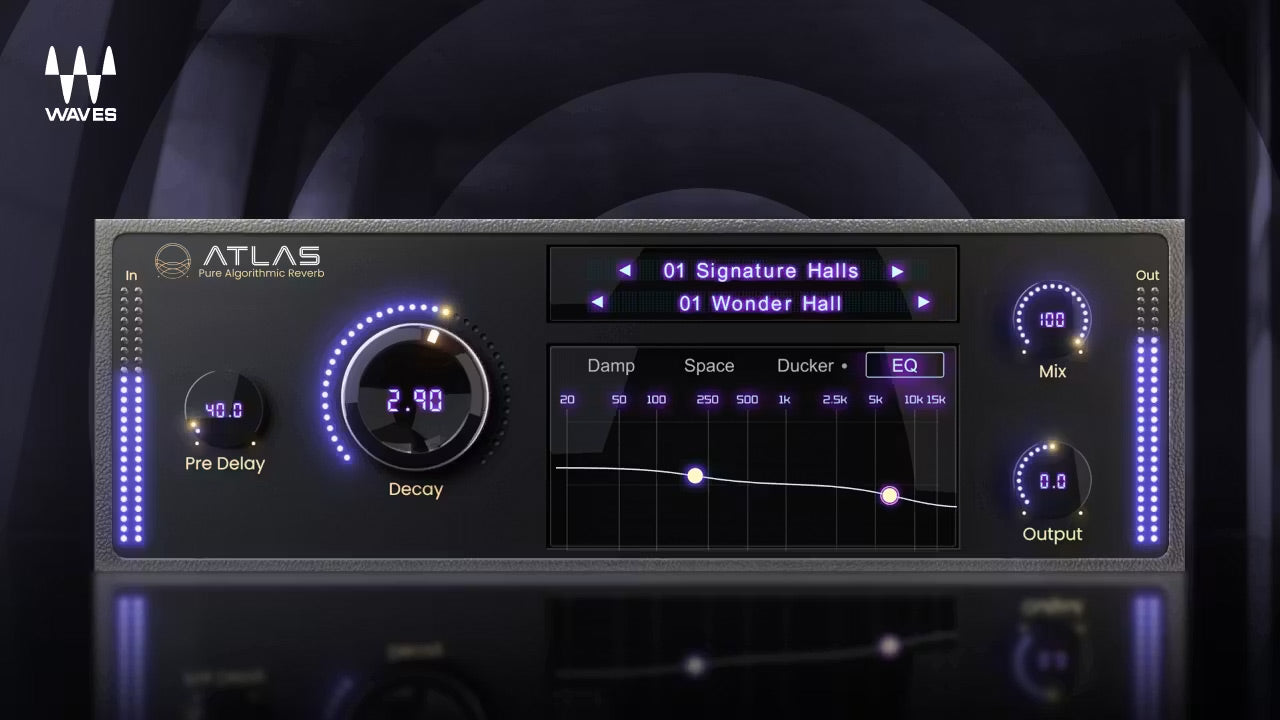
That's exactly the problem Waves is taking aim at with Atlas Reverb, a brand-new, fully algorithmic reverb plugin announced this week. No convolution, no impulse responses — just a ground-up DSP engine and more than 100 reverb programs that Waves says were tuned entirely by ear, specifically for how they behave in real records.
Let's dive into what makes this a game-changer.
Tuned by Ear, Built for Real Mixes
The headline story here isn't a new algorithm buzzword — it's the tuning process. Waves says every one of Atlas's 100+ programs went through hundreds of hours of human listening, refined for tone, density, reflection behaviour, modulation, depth and decay until it worked inside actual music, not just in isolation. That's a meaningful distinction. Plenty of reverbs flatter a single track in solo; far fewer keep their shape once the drums, bass and guitars pile in. Atlas has been voiced for the second scenario from day one.
Classic DSP Flavours, Reimagined
If you grew up on the sound of classic digital reverb hardware, Atlas will feel like familiar territory. The program library draws on the great DSP reverb flavours — lush halls, dense plates, wide chorus spaces, gated effects and those larger-than-life '80s textures — but each one is Waves' own take, built from scratch on the new engine rather than sampled from old boxes. It slots into the Waves range as their purely algorithmic design, distinct from the convolution-based tools elsewhere in their catalogue.
A Reverb That Listens Back
Where Atlas gets properly interesting is its dynamic detection system. Rather than sitting static like a fixed impulse response, each program reacts to what you feed it — the space responds differently to a whispered vocal than it does to a cracking snare. The goal is a reverb that feels alive inside the mix, moving with your performance instead of just sitting behind it.
Fast Workflow, Light on Your CPU
Waves has kept the controls deliberately simple, focusing on musical, mix-ready parameters rather than deep technical menus, and built a streamlined browsing workflow so you can flick between programs quickly and judge each one against your track in progress. Combined with low latency and low CPU usage, that positions Atlas as an everyday workhorse — for big sessions, and even live mixing — rather than an occasional special effect.
Key Details
- Pure algorithmic engine: an all-new DSP design with no convolution or impulse responses involved.
- 100+ ear-tuned programs: halls, plates, chorus spaces, gated reverbs and big '80s-style textures, each voiced for use inside full mixes.
- Dynamic detection system: programs respond to the source material, so spaces react rather than sit static.
- Streamlined workflow: fast program browsing with simple, musical controls — no deep menu-diving required.
- Low latency, low CPU: designed to run comfortably across demanding studio sessions and live mixing.
- Pricing: available now at an intro price
See It in Action
Between the ear-tuned program library, the dynamic response and the classic DSP pedigree, Atlas looks like a serious contender for the "default reverb" slot in a lot of sessions. If your current go-to sounds better in solo than it does in the mix, this one deserves an audition.
Ready to add it to your toolkit? Shop Waves at Koala Audio.