




















You know the feeling. Three hours into a mix on headphones, everything sounds enormous — then you play it in the car and the low end has vanished, the vocal is buried, and the whole thing feels oddly flat. Headphones aren't lying to you out of malice. They're just putting the sound inside your skull instead of in a room, and your ears have spent a lifetime learning to judge music the other way around.
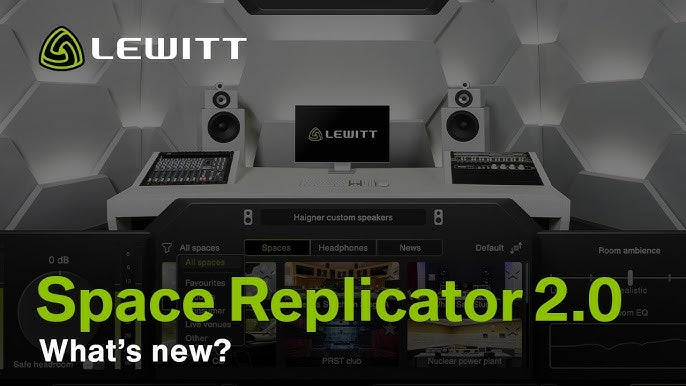
Space Replicator 2.0 is Lewitt's answer to that, and this update turns what was already a smart speaker-and-room virtualisation plug-in into something you can build a genuine workflow around. It simulates the experience of listening to real monitors in real acoustic spaces, then delivers that to your headphones — so the decisions you make at 2am actually hold up in daylight.
Let's dive into what makes this a game-changer.
Standalone Mode: Monitoring Beyond the DAW
The headline change in Space Replicator 2.0 is that it no longer needs a DAW. There's now a standalone version, which means the virtual room follows you everywhere — reference listening, client playback from a streaming service, checking a bounce, reviewing a mix on a laptop in a hotel room. Anywhere your system audio goes, your calibrated listening environment can go too.
Lewitt have also given the whole engine an audio quality and performance overhaul, with zero-latency operation. That last point matters more than it sounds: latency in a monitoring chain is the fastest way to make tracking feel unplayable, so having the room simulation sit transparently in the signal path keeps it usable while you're recording, not just while you're mixing.
Rooms You Can Shape to Your Own Ears
The biggest complaint about virtual monitoring tools has always been that you're stuck with someone else's idea of a good room. Version 2.0 addresses that directly with per-room EQ and an adjustable room ambience control, so you can dial the amount of space in or out depending on whether you want a dry analytical picture or something closer to a real control room.
On top of that there's a new output EQ for tuning the overall sound, a variable blend for headphone compensation — use as much or as little as you like rather than accepting a fixed correction curve — and a balance slider to compensate for uneven headphones or asymmetric hearing. That last one is a quietly thoughtful inclusion. Plenty of engineers have one ear that hears differently to the other, and very few monitoring tools acknowledge it. You can save your setups as user presets once you've found what works.
New Spaces and New Headphone Models
Two new virtual rooms arrive with the update. The first is an ideal mixing room built to the official European Broadcasting Union standards, which gives you a genuinely neutral reference point rather than a flattering one — handy if you're delivering to broadcast. The second is an Analytic space, paired with ideal speakers, designed for critical listening when you need to hear problems rather than enjoy the music.
Three new headphone simulations have been added as well — the H-M50 x, H-770 and H-7506 — covering models that turn up constantly in studios and edit suites. If your clients or collaborators are working on a common pair, you can hear roughly what they're hearing before you send the file.
The Essential Edition Gets Better Too
Space Replicator also comes in a stripped-back Essential edition, and it hasn't been left behind. Essential users now get personalised binaural profiles for a more accurate stereo image, plus a free new acoustic space: a living room, with smartphones and laptops available as selectable playback systems. Given how much music is consumed on exactly those devices, being able to audition your mix through that lens is a practical translation check rather than a novelty.
Worth knowing: an Essential licence is already included in the software package supplied with Lewitt's Connect audio interfaces, so you may own a copy without realising it.
The Specs That Matter
- Standalone plus plug-in — run it without a DAW, or inside one as VST3, AU or AAX.
- Zero-latency performance — the room simulation stays out of the way while you track.
- Per-room EQ and ambience control — shape each virtual space to your taste instead of taking it as supplied.
- Two new rooms — an EBU-standard ideal mixing room and an Analytic space for critical listening.
- Three new headphone simulations — H-M50 x, H-770 and H-7506.
- Variable headphone compensation and balance slider — correct for your headphones and your own hearing.
- System requirements — Windows 10 or later, macOS 12 or later.
Should You Care?
If you own a well-treated room and a set of monitors you trust, this is a convenience. If you mix on headphones — in a shared house, on the road, late at night, or simply because that's your setup — this is closer to essential infrastructure. The 2.0 changes are the ones that move it from an interesting demo to a tool you'd actually leave switched on, particularly the standalone mode and the ability to tune the rooms rather than accept them.